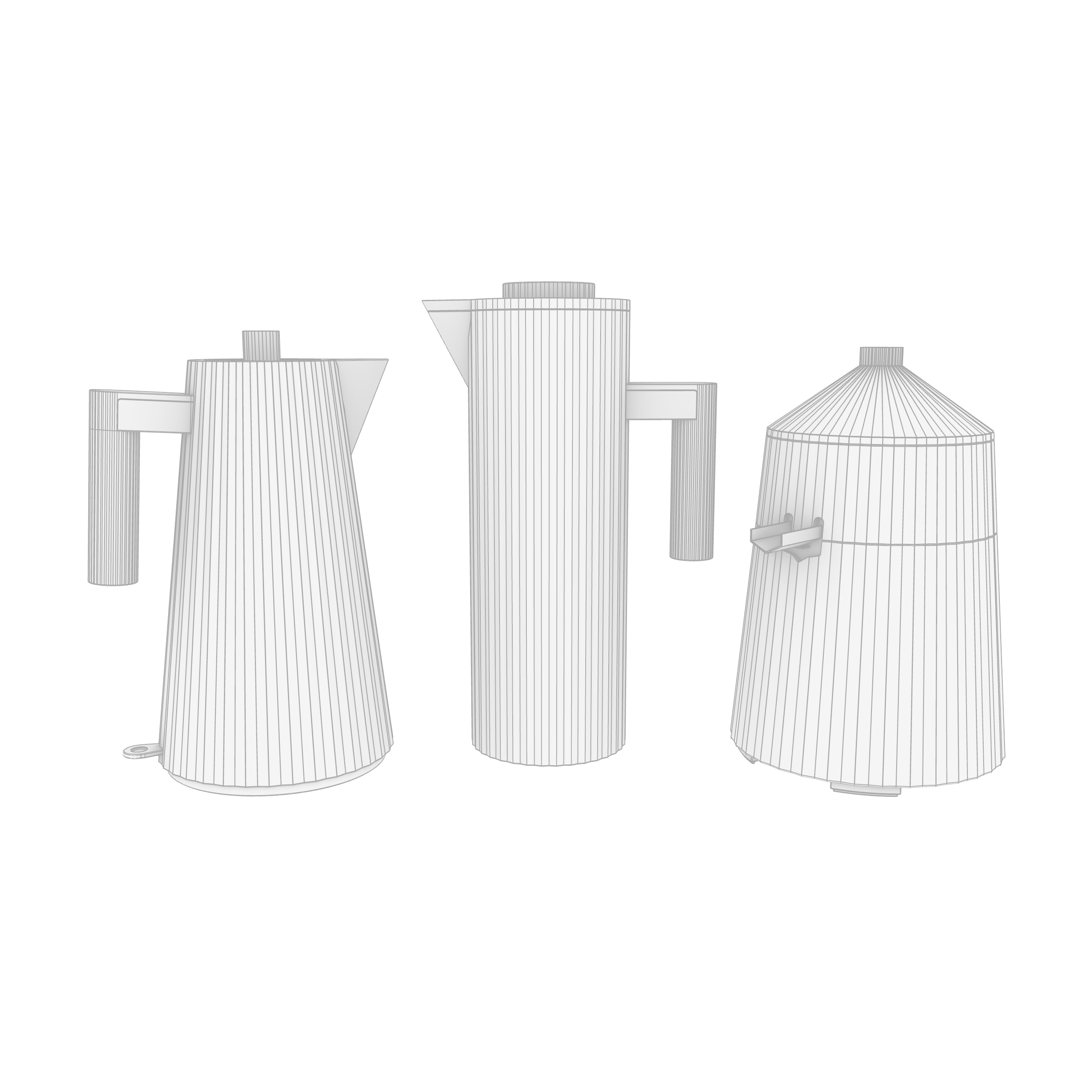
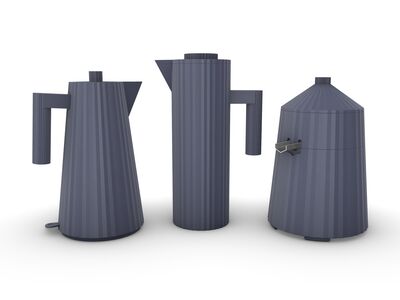
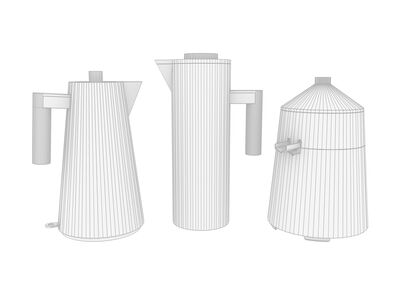
Alessi_Plissé Set
Editorial License More Informations
Product Features
3d Modeled With Nurbs
Real product
Category Jugs
Typology Dark
Style
Modern Mid CenturyDescription
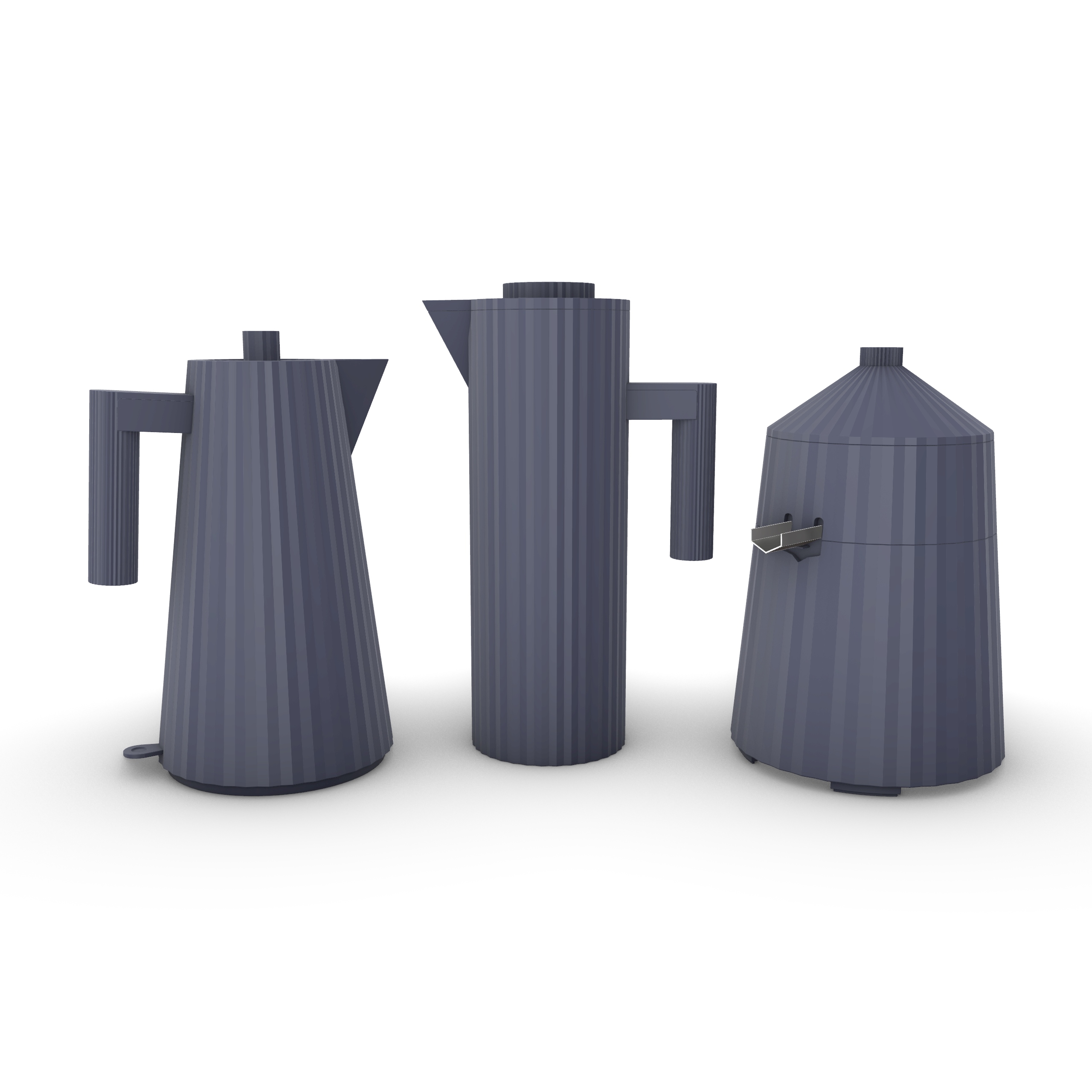
Plissé Set is a high-quality model modeled in NURBS, divided by layer to handle different elements and materials of the model more efficiently.
The model has a fully textured, detailed design that allows close-up renders.
3d file is originally modeled in Rhinoceros, and the preview is done with Rhinoceros Render view and has no postprocessing.
Product Details
The Plissé serie combines functional aspects with a plastic and fascinating design that reveals the creator's architectural background, as well as his passion for the handicraft and for sculpture. Like a fabric that a thick pleating transforms into a three-dimensional shape, this kettle is reminiscent of an haute couture dress, a beautiful object to be left on display on your kitchen top.
Brand
Alessi is a leading Italian design company that creates a wide range of household products, including kitchenware, home accessories, and furniture. Established in 1921, the brand is known for its innovative and stylish designs, which are often a fusion of art and functionality.
Alessi's products are designed by renowned designers from around the world, who collaborate with the company to create objects that are both aesthetically pleasing and practical. The brand's products are made using high-quality materials, such as stainless steel, glass, and porcelain, and are manufactured using advanced technologies to ensure durability and longevity.
The brand's iconic designs, such as the Juicy Salif citrus squeezer and the Michael Graves kettle, have become instant classics and are featured in museums and galleries around the world. Alessi's products are known for their unique shapes, bold colors, and playful details, which add a touch of sophistication and elegance to any home.
Overall, Alessi is a brand that is synonymous with innovative design, quality craftsmanship, and Italian style. With its commitment to creativity, craftsmanship, and innovation, Alessi continues to push the boundaries of design and create products that are both beautiful and functional.
Designer
Michele De Lucchi was born in Ferrara in 1951. After graduating from the Faculty of Architecture in Florence, he began working as an assistant to Adolfo Natalini in the Design course. During this period, he became involved with the radical design movement, which led him to co-found the Cavart group, and proved to be a fundamental push for his future career. Later, he moved to Milan where he became friends with Ettore Sottsass and worked with him in one of the most representative groups of postmodernism in the 1980s, the Memphis group, a collective committed to creating a new language that played with the recovery of kitsch elements from the 1970s and preferred plastic and laminated materials, with a clear vocation for the rationalism of industrial production. During this period, De Lucchi also participated in other important collective experiences of the time, such as Centrokappa and Alchimia.Thanks to Ettore Sottsass, starting in 1979, De Lucchi began his collaborations with Olivetti, as a consultant for the design of the Syntesis in Massa, and then, in 1984, with Olivetti in Ivrea, until becoming the head of the design office from 1988 to 2002. In parallel with his commitment to Olivetti, the architect continued to work independently, winning prestigious projects such as the interior design of Deutsche Bank's offices, Poste Italiane, and Intesa San Paolo, for which he was involved in designing credit cards as well as the interior design of the Piazza della Scala headquarters in Milan. He also completed projects for Enel, Telecom Italia, and Piaggio.In 1989, he received the prestigious Compasso d'Oro award for the "Tolomeo" lamp, created for Artemide. "Tolomeo" was the result of an intuition: to innovate the classic desk lamp with a pantograph, an object that was born with a declared technical and functional purpose and that recalls the imagery of the office and design, making it an elegant and modern furnishing accessory. "Tolomeo," which also compares with some icons of past design such as FontanArte's "Naska Loris" from 1933 and Jac Jacobsen's "Luxo" from 1937, later made famous by the Pixar logo, was an object destined to become a best-seller from the start. His collaboration with Artemide has led to the creation of many other lamps, in addition to the rich collection of Tolomeo lamps: Castore, Dioscuri, Ipno, Logico. Among the other companies he has collaborated with are Alias, De Padova, Poltrona Frau, Caimi, Glas Italia, iGuzzini, Danese, and De Castelli.In 1990, he decided to found his own brand, Produzione Privata, with which he creates furnishings, without abandoning his work as a designer, which sees him involved in exhibitions and museum installations, such as the Neues Museum in Berlin, or in restorations, such as the Design Museum at the Triennale di Milano or the former Agip gas station in Piazzale Accursio, Milan. Since 2017, Michele De Lucchi has been the director of the Domus magazine. His editorial line is characterized by the mixing of disciplines and content, ranging from Design to Philosophy, with a constant research aimed at investigating space and objects in relation to humans.